
Last updated November 16, 2026
 AC repair
 Furnace & heating
 Heat pumps
 Ductless mini splits
 Carrier
 Trane
 Goodman
Seasonal tune-up and full diagnostic on your Carrier, Trane, or Goodman system - readings shown to you before any repair is proposed
Diagnosis first, numbers second - you approve the repair price before a single part goes in.
Get your free estimateHVAC Warning Signs: A Clearwater Homeowner’s Reference Guide
Most HVAC failures announce themselves well before the system quits. The trouble is that the first announcement rarely looks like an emergency. It looks like a slightly higher power bill. A faint rattle you tune out. A room that takes ten minutes longer to cool than it did last month. Homeowners blame the utility, the thermostat, or a stretch of hot weather, and by the time the system finally stops, the small signal has become a larger repair. This guide is built to change that. We’ll decode the specific sounds, smells, airflow changes, and bill jumps that point to real problems, show you which are safe to wait on and which mean shut it down now, and explain how to describe a symptom so a technician diagnoses it accurately the first time. If you live in Clearwater, several of these signs show up here for reasons they don’t elsewhere, and we’ll cover those too.
Quick Answer
The most reliable early HVAC warning signs are a sudden jump in your electric bill without a change in usage, weak or uneven airflow, strange noises like rattling or hissing, musty or burning smells, and short cycling (the system turning on and off every few minutes). Signs that mean turn the system off and call immediately include a burning smell, a hissing sound near the refrigerant lines, water pooling around the air handler, or a complete loss of cooling during extreme heat. Everything else is usually a “schedule it this week” situation rather than an emergency, but accuracy matters: describe the symptom clearly and a technician can tell you which is which before they arrive.
Styles & brands we work with
- AC repair
- Furnace & heating
- Heat pumps
- Ductless mini splits
- Carrier
- Trane
- Goodman
Table of Contents
- Start With the Bill: The Most Ignored Warning Sign
- The Symptom-to-Cause Reference Table
- Clearwater-Specific Warning Signs
- Short Cycling: Why It Matters More Here
- How to Triage: Wait, Schedule, or Shut It Down
- How to Describe a Symptom So You Get a Real Diagnosis
- Repair or Replace? Reading the Signs Together
- What Regular Checks Actually Catch
Start With the Bill: The Most Ignored Warning Sign
A sudden jump in your electric bill is one of the most reliable early warning signs of an HVAC problem, and one of the most ignored. Homeowners blame the utility company before they think to check the system. That habit costs them, because a cooling system that has to run longer to hit the same temperature is burning extra electricity every single day it stays unfixed.
When we look at a bill spike alongside the system, here’s what we’re reading it against. A dirty condenser coil, low refrigerant charge, failing capacitor, or a blower motor working harder than it should all push runtime up. A system that used to cool the house in twenty minutes and now takes forty is doing roughly double the electrical work for the same result. The bill is the clearest paper trail you’ll get, and it arrives before the breakdown does.
To read your own bill usefully, compare the same month across two or three years, not one month to the next. Seasonal swings in Clearwater are big, and a July bill will always look worse than an April one. The signal you want is the same month climbing faster than it used to. If August is running noticeably higher than last August and nothing changed in your household, that’s a system question, not a utility question.
Pair the bill with a second reading: runtime. On a normal afternoon, count how long the system runs before it shuts off and how long it stays off. Most healthy systems settle into a rhythm. A system that’s crept toward near-continuous running or toward very short bursts is telling you something before it breaks. If either pattern shows up, Millbrook AC Repair can look at it before it turns into a mid-summer emergency.
The Symptom-to-Cause Reference Table
The table below maps what you’re hearing, smelling, and feeling to its most likely cause in plain language. It’s a starting point for a conversation, not a diagnosis: several symptoms overlap between causes, and only a technician on site can confirm. What it does is get you from “something’s wrong” to “here’s what I’m dealing with,” which is often the difference between a fast fix and a fishing expedition.
Sounds
- Rattling from the outdoor unit – loose panels, a failing fan blade, or debris that’s worked its way into the housing. Usually a “schedule it” item unless it’s loud and constant.
- Clicking that repeats – a failing capacitor, contactor, or control board trying to start the system over and over. Shut it down if cooling is also lost.
- Hissing near the indoor or outdoor unit – a refrigerant leak. Shut the system off and call; running it low on refrigerant stresses the compressor.
- Screeching or squealing – a worn belt or a blower or fan bearing about to fail. Schedule it promptly; a seized bearing can take a motor with it.
- Banging on startup – a loose or broken internal component. Turn it off and call.
Smells
- Musty or damp – growth in the drain line or evaporator area. Common in humid climates and worth scheduling.
- Burning or hot plastic – electrical trouble. Shut the system off at the thermostat and call immediately.
- Rotten eggs or sulfur – not an HVAC smell in most homes, but if you have any gas appliance, treat it as a gas concern and call your gas provider first.
- A faint sweet or chemical odor – refrigerant. Shut it off and call.
Airflow and Temperature
- Weak airflow from vents – a clogged filter, a failing blower, or duct restriction.
- Cold air that isn’t cold enough – low refrigerant, dirty coils, or a compressor losing capacity.
- One room warm, the rest fine – a balancing or duct issue rather than the system itself.
- Long, near-continuous running – inefficiency or a system that’s undersized for the house.
Bill and Behavior
- Same-month bill climbing – dirty coils, low charge, or failing components.
- Short cycling – oversized system, low refrigerant, or a failing thermostat or control board.
- System won’t keep up on a hot day – could be inefficiency, could be the equipment is finally beyond fixing. Worth a full evaluation rather than a guess.
Clearwater-Specific Warning Signs
Generic HVAC guides list the same ten symptoms everywhere. In practice, the climate and housing here put weight on a few signs that barely show up in drier markets, and those signs are often the first ones to look at. Clearwater summers are long and humid, and humidity is what drives most of the local-specific trouble.
Rust Streaks Near the Air Handler
If you see rust or water staining at the base of the air handler or around the condensate drain, take it seriously. That staining usually means water is escaping somewhere it shouldn’t, either from a clogged drain line, a cracked drain pan, or condensation forming where the system wasn’t designed to shed it. Left alone, it can soak insulation, feed growth, and eventually reach the surrounding structure. In a humid market like Clearwater, an air handler that can’t drain properly is a slow-blooming problem, not a cosmetic one.
Biological Smell From the Drain Line
The musty smell homeowners describe as “the house just smells damp” is often the drain line. Warm, moist condensate sitting in the line is a place where growth accumulates, and the smell can push back into the airstream. It’s a signal that the drain is overdue for a flush and that the system’s moisture handling deserves a look. Clearwater’s humidity means this line works harder than it would in a dry climate, so it’s worth checking on a routine basis rather than waiting for the smell.
Coil Corrosion Indicators
Coil surface damage shows up as visible pitting, blue-green residue, or a fuzzy white buildup, usually on the outdoor unit. A coil that’s losing surface area can’t shed heat the way it used to, so the system runs longer for less cooling. If you see the coating breaking down, get it looked at before the problem advances.
Why These Matter Here
All three signs share a common thread: they’re moisture and heat related. Clearwater homes live with that combination most of the year, so the small clues that come from humidity tend to arrive earlier than the dramatic ones. When we work on Clearwater homes, we check these first because failing to catch them adds up quietly. For additional local context, our AC installation page walks through what a properly sized and matched system looks like for a Clearwater house.
Short Cycling: Why It Matters More Here
Short cycling is the pattern where the system turns on, runs for two to four minutes, shuts off, and does it again – over and over. Most homeowners don’t recognize it as a problem because the house stays cool. That’s the trap. The system is working, just badly, and the wear adds up every cycle.
What It Looks Like in Practice
- You notice the system kicking on more often than it used to, or that it cycles several times an hour.
- The room feels cool but not evenly cool – some spots stay warm while others are fine.
- The outdoor unit starts with a louder-than-usual click or hum.
- The thermostat is set to a temperature the system hits and then loses quickly.
- You hear the cycling from a room near the air handler.
Why It’s a Bigger Deal in Clearwater Humidity
Air conditioning does two jobs: it cools, and it dehumidifies. The dehumidifying happens while the system is running. A system that cycles in and out every few minutes never runs long enough to pull meaningful moisture out of the air. In a dry climate that’s a minor comfort issue. In Clearwater, where outdoor humidity runs high through much of the year, it’s a much bigger problem: the indoor humidity creeps up, the house feels clammy at the same thermostat setting, and the conditions that feed musty smells and drain-line growth get better. Short cycling is a cooling symptom with a moisture consequence, and the two are usually treated together.
Common Causes
- Oversized equipment – a system with more capacity than the house needs cools too fast, then shuts off.
- Low refrigerant charge – the system hits its pressure limit and shuts down to protect the compressor.
- Failing thermostat – reading temperature incorrectly and telling the system to stop early.
- Failing capacitor or control board – interrupting the start or run cycle.
- Clogged filter or restricted airflow – the system overheats on the indoor side and cuts out on a safety.
Because short cycling can be caused by a cheap part or by an equipment sizing problem that no repair will solve, the right move is a real diagnostic. If the equipment turns out to be the issue, we can install a properly matched system – we work across Carrier, Trane, Lennox, and six other major brands, so the recommendation follows the house, not a single dealer line.
How to Triage: Wait, Schedule, or Shut It Down
Not every warning sign needs the same response. Some are safe to schedule for the coming week while you keep using the system. Others mean shut it off and call a professional before running it another minute. Sorting the two correctly protects both your comfort and your equipment. Here’s how we triage.
Shut It Down and Call Now
- Burning smell – electrical hazard. Turn the system off at the thermostat and call immediately.
- Hissing near refrigerant lines – active leak. Running the system low on charge can damage the compressor.
- Water pooling near the air handler – overflow that can reach the structure. Cut power and call.
- Loud banging or grinding on startup – internal mechanical failure. Don’t restart it.
- Complete loss of cooling in extreme heat – a heat-safety issue, especially for anyone elderly, very young, or with health conditions.
Schedule It This Week
- Musty smell.
- Weak airflow.
- Short cycling without other symptoms.
- A bill that’s climbed but the system still cools.
- Rust streaks or staining.
- Rattling that comes and goes.
Monitor, Then Decide
- A single higher month that might be weather.
- One room that’s slightly warm compared to the rest.
- A faint smell you can’t place.
For anything in the “monitor” column, watch it for a couple of weeks. If it resolves on its own, you’ve learned something. If it drifts into a “schedule” symptom, get it looked at. If a question can’t wait, call. We answer 24/7. Fast dispatch, 7am-7pm, Sunday through Friday. If you call outside dispatch hours, we’ll book you into the next opening.
How to Describe a Symptom So You Get a Real Diagnosis
A vague complaint like “the AC isn’t working right” sends a technician out without a target, and a service call that should be five minutes becomes an hour of searching. Specific details shorten the diagnosis and often let us tell you before we arrive whether you’re looking at a quick fix or a bigger conversation. Here’s the checklist we ask homeowners to work through before they call.
- Name the symptom precisely. “Rattling from the outdoor unit only when it starts” is different from “rattling that’s constant.” Both point to different causes.
- Note when it happens. Only on startup? After the system has run for a while? Only on the hottest part of the day? Timing narrows the field.
- Note how often. Every cycle, once a day, only when the system runs a long cycle.
- Check the bill side by side. Same month, last year and this year. If you spot a climb, mention it – it tells us something about efficiency even if the symptom looks unrelated.
- Read the thermostat against the thermometer in the room. If you have a simple thermometer, put it near a vent and let it run for an hour. If the thermostat is showing 74 and the vent air isn’t measurably cool, that’s useful information.
- Describe the smell or sound in plain terms. Not “weird,” but “musty,” “burning,” “sweet,” “grinding,” “clicking.” Every one of those points somewhere different.
- Mention the system’s approximate age and brand. We work on Carrier, Trane, Lennox, Goodman, Rheem, York, Daikin, Bryant, and American Standard. Knowing the brand helps us bring the right parts and approach.
- Note anything that changed recently. A new filter, a breaker that tripped, a power surge, a recent painted room, or a visit from another contractor.
Here’s an example of a useful call: “My system runs about three minutes then shuts off. It does it about five times an hour. The thermostat’s set to 75, the house holds 78 in the afternoon, and last August’s electric bill was higher than the year before. It’s a Trane, around ten years old.” That single sentence tells a technician the system is short cycling, the house is under-cooled, and efficiency has dropped. From that alone, we know what to bring.
Repair or Replace? Reading the Signs Together
Any single warning sign is a repair question. Several signs stacking up starts to become a replacement question, and the right answer depends on what’s actually adding up. The signs that push toward replacement are different in nature from the signs that point to a fixable part.
Signs That Usually Mean a Repair Is the Right Call
- One specific noise with a clear cause (a fan blade, a capacitor, a belt).
- Short cycling that traces back to a component.
- Musty smell or drain issue.
- A single higher bill that came on abruptly.
- Water staining without compressor symptoms.
Signs That Point Toward Replacement
- Runtime that’s crept up over multiple seasons, not one cycle.
- Coil damage that reduces capacity and isn’t a one-off.
- Repeated short cycling that persists after a part fix.
- A bill that climbs year over year, not month over month.
- Equipment that’s undersized or matched poorly to the house.
The clearest signal is a pattern. A single repair is one repair. A repair that brings a second repair that brings a third within a short span is the equipment telling you it’s finished. When it comes, the choice of what goes in next is worth taking seriously. We work across nine major brands because the right system is the one that matches your house, your ductwork, and your budget, not the one a single-brand dealer is set up to sell. If your system is on the way out, we’d rather have that conversation now than during a heat wave.
What Regular Checks Actually Catch
Maintenance is often sold as a generic “keep it running smooth” line. That’s not what actually happens when a technician runs through a system. A real inspection catches the small things that turn into warning signs later: a drain line that’s starting to clog, a capacitor reading below spec, a contactor with pitting on the contacts, a coil surface starting to foul, a filter that’s been forgotten. These are the things that later show up as the symptoms in the table above.
The single most useful thing a homeowner can do between visits is replace the air filter on schedule and check the drain line. Beyond that, an annual look before the cooling season is the best way to spot early signs before summer heat makes every small inefficiency bigger. If you’re in Clearwater and heating matters too – a furnace going into its first cool season after a quiet summer is a common failure point – our furnace repair page covers the heating-side signs worth watching. A system that’s checked heading into cooling season and again heading into the cool months gets caught before it becomes a problem.
One thing people don’t realize is how much maintenance pays for itself in the bill. A dirty coil alone can add noticeable runtime to every cycle. Getting that caught before a hot stretch hits is worth the visit.
Common Mistakes to Avoid
- Blaming the bill on the utility first. Utility rates do move, but if the same month is climbing year over year, the utility isn’t the story. Check the system before you call the power company.
- Waiting for the system to fail completely. It’s tempting to use it while it still cools. A failing capacitor or a low charge that gets left can take the compressor with it, and compressors cost far more than the part that failed first.
- Running the system with a chemical or burning smell. Some smells are a nuisance. Burning or sweet chemical smells are a hazard and a signal to shut the system off.
- Ignoring musty air in a Clearwater home. A musty smell in a dry climate is a minor comfort issue. Here it’s usually the drain line and the humidity it’s driving. Defer it and the conditions compound.
- Trusting a single-brand quote on a failing system. If you’re choosing new equipment, get a recommendation tied to your house, not to one manufacturer. We’re equipped for Carrier, Trane, Lennox, Goodman, Rheem, York, Daikin, Bryant, and American Standard, precisely so the choice isn’t narrowed by the brand on the truck.
- Describing symptoms in the vaguest possible terms. “It’s not working right” forces a technician to search from zero. Specifics speed up the diagnosis.
- Mistaking short cycling for the system working. A house that stays cool is not a system that’s fine. If the unit turns on and off every few minutes, that’s a warning sign, not normal operation.
- Skipping the drain line because it’s out of sight. Condensate lines are a common cause of water damage and musty smells in humid homes. A quick check catches a lot.
See the difference
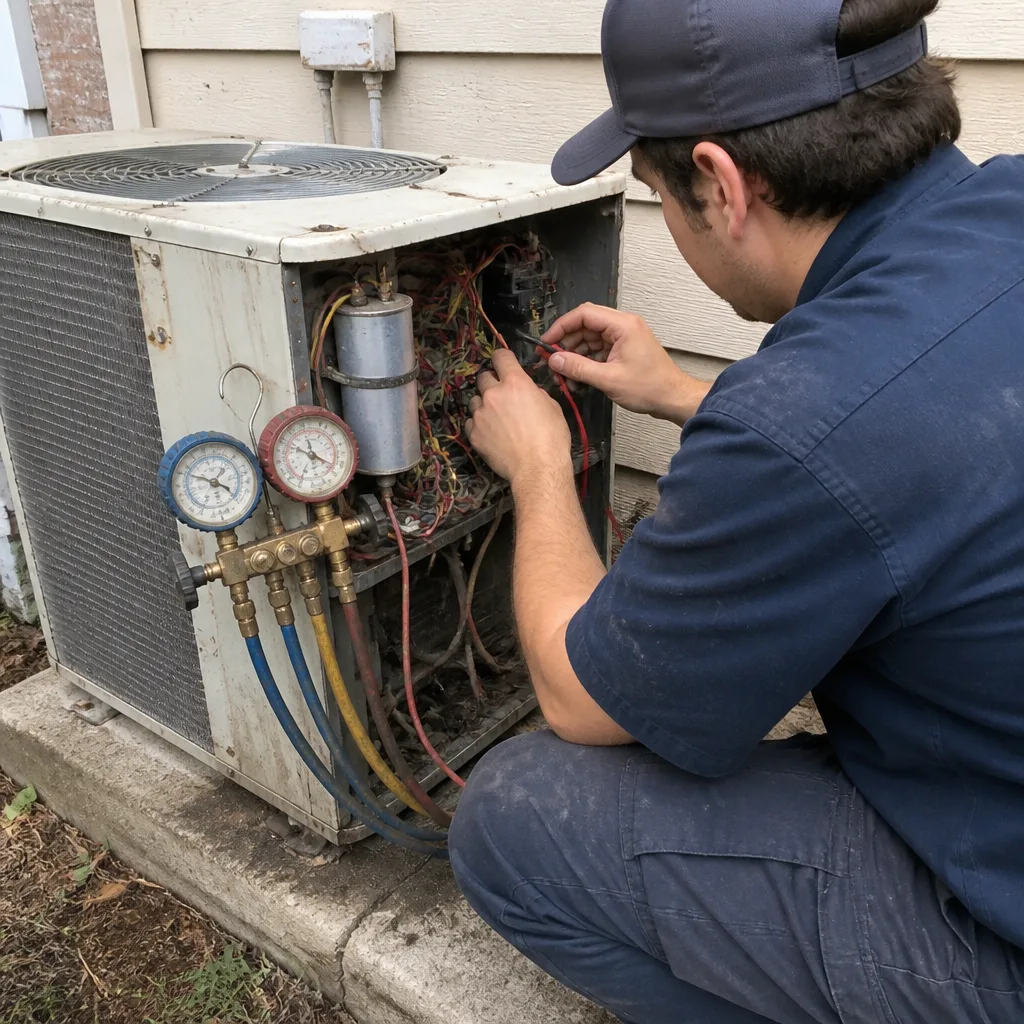 Before
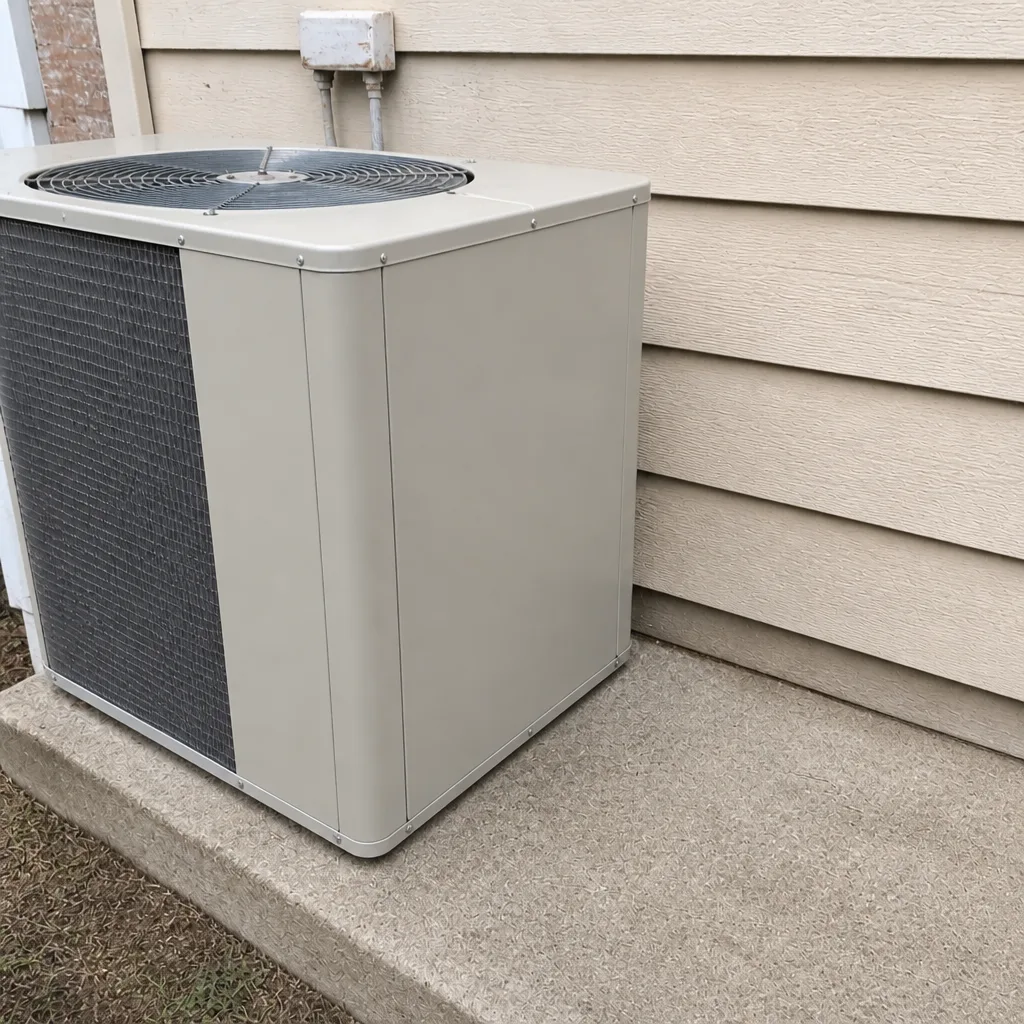 After
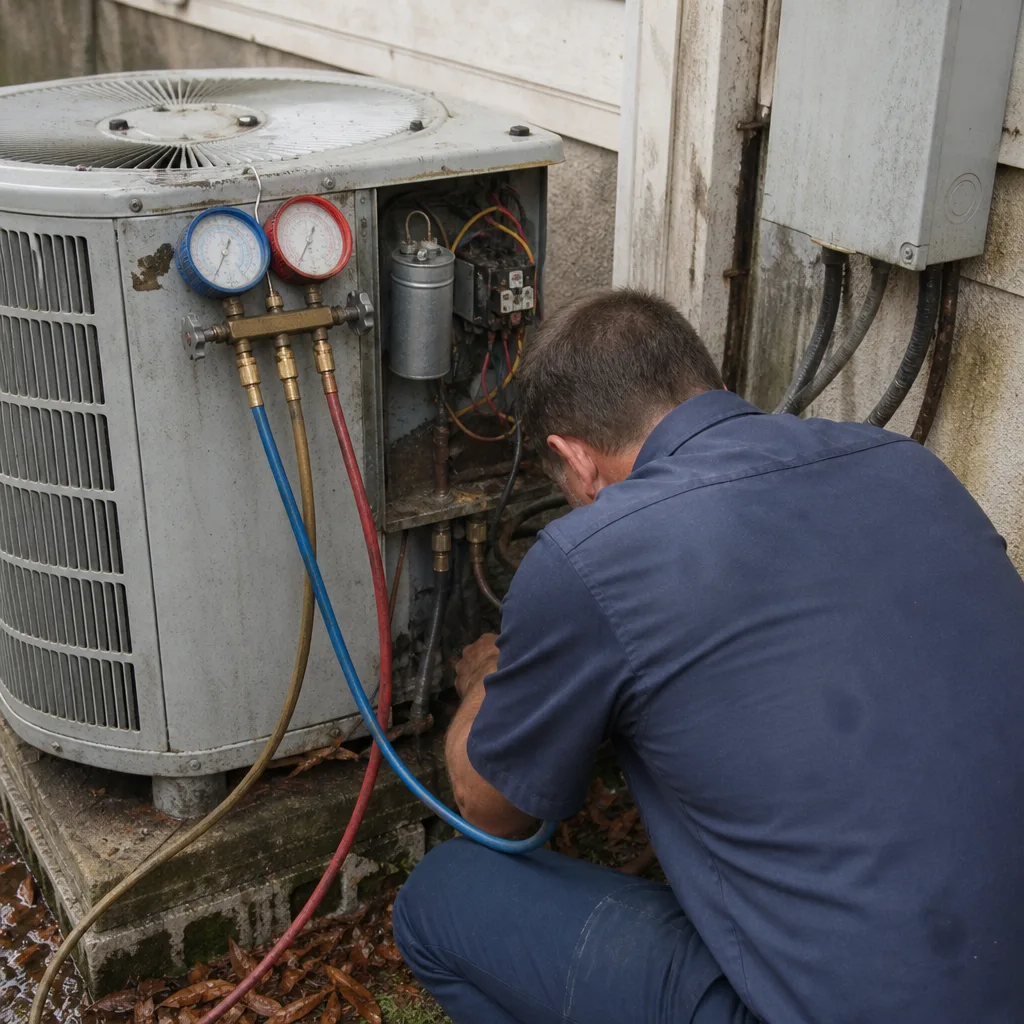 Before
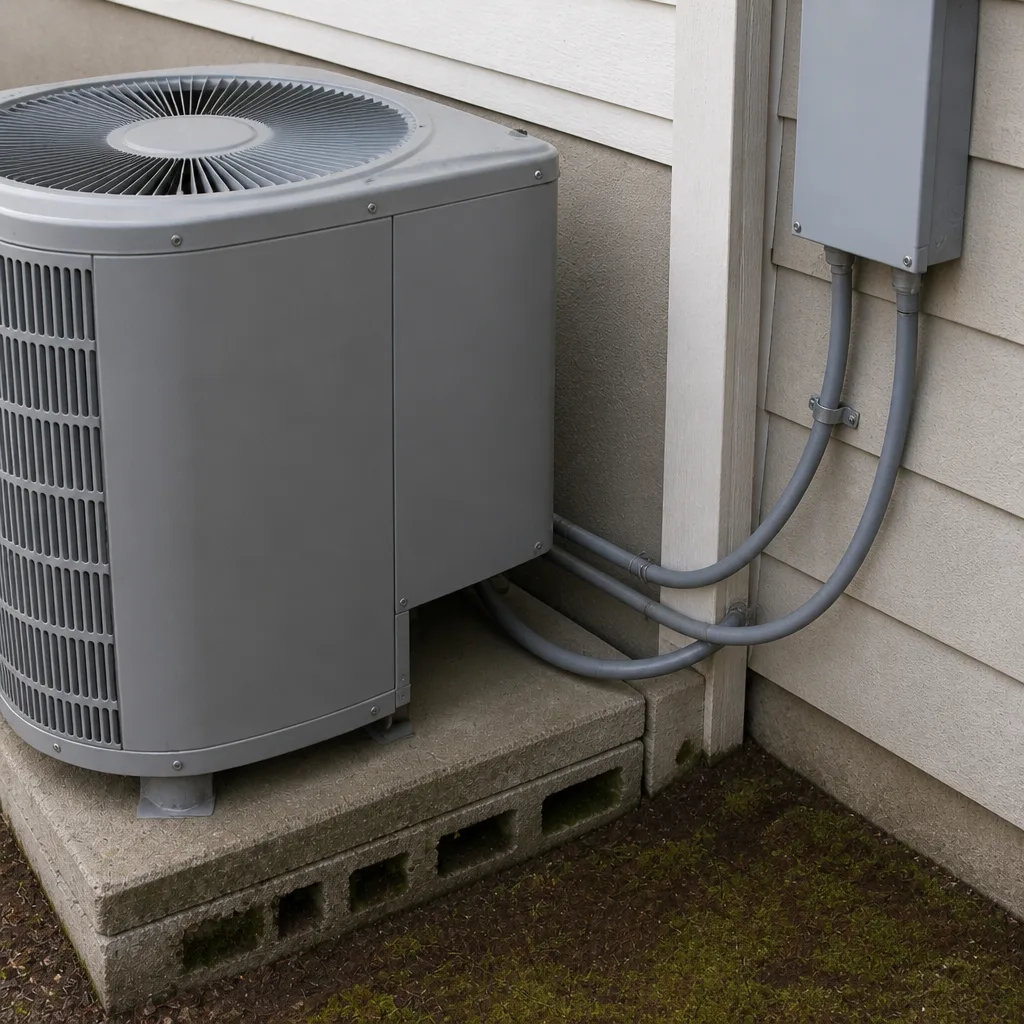 After
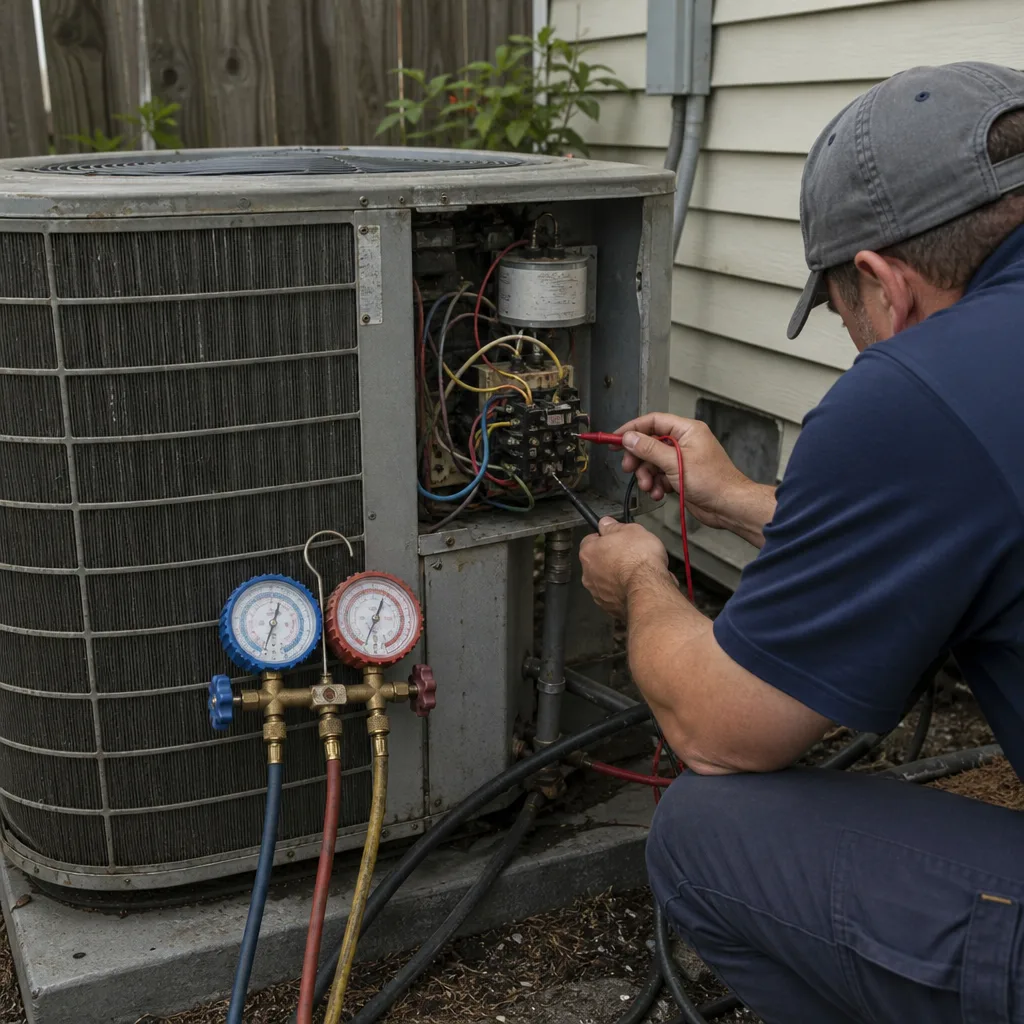 Before
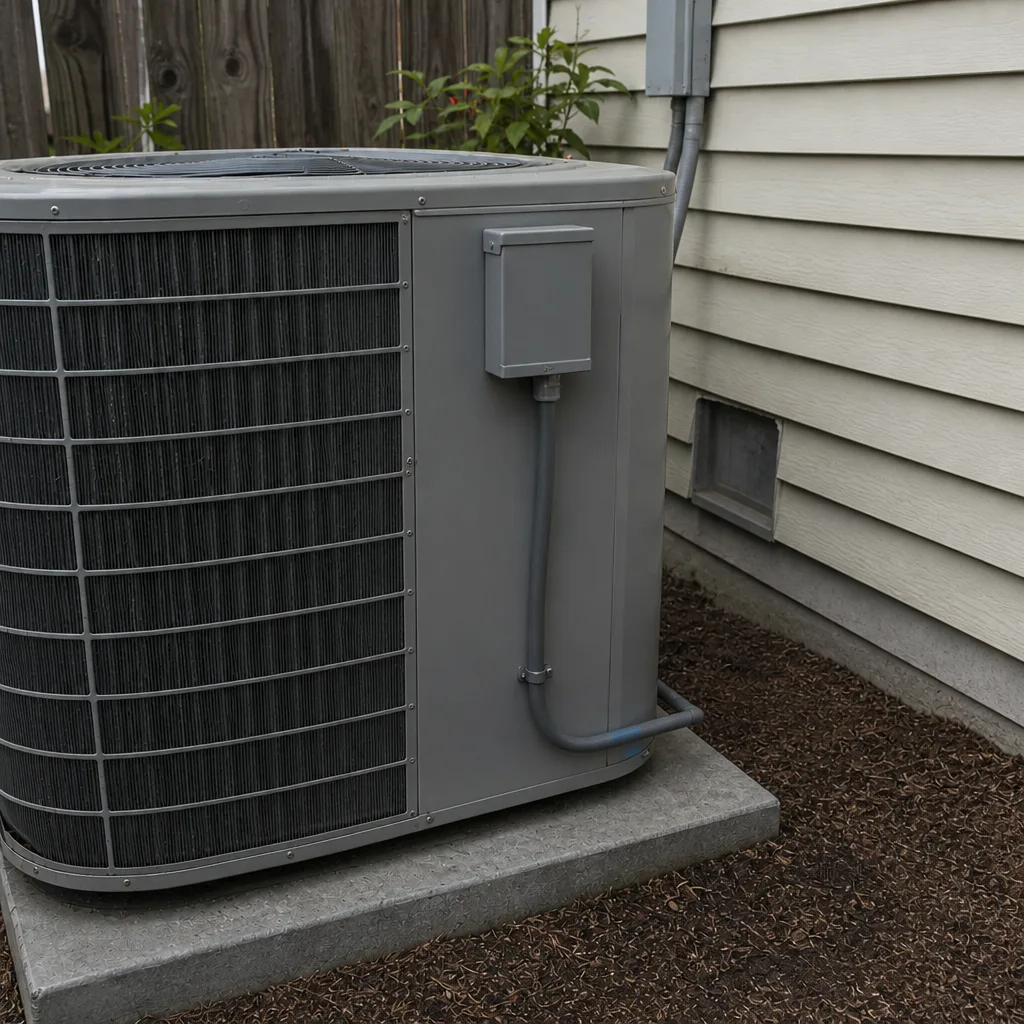 After
When to Call a Professional
Call a professional when the symptom is a hazard – burning smell, hissing near refrigerant lines, water pooling, loud banging, or complete loss of cooling during heat. Call when a symptom has been in the “monitor” column for two weeks and hasn’t resolved. Call when a bill has climbed on a same-month comparison and stayed up. Call before the system reaches the point where choice is taken away and replacement is the only path, because every repair is cheaper than an emergency install on a hot afternoon. And call if you’ve had work done and aren’t sure whether what you’re hearing or smelling is normal. Millbrook AC Repair offers free estimates in Clearwater – call (855) 360-7082. We answer 24/7, with fast dispatch from 7am to 7pm, Sunday through Friday. Same-day service is available when the schedule allows, and the price is set by the written estimate.
Frequently Asked Questions
The earliest signs are usually behavioral, not dramatic: a higher same-month electric bill, longer runtime, weak or uneven airflow, and short cycling. Because Clearwater’s humidity is high for much of the year, musty smells and drain-line staining tend to show up early too. Any of these in isolation is a “schedule it” moment; two or three together is worth a proper look. Call (855) 360-7082 for an exact quote on a diagnostic visit – estimates are free.
If the noise is a burning smell, loud banging, grinding, or hissing near refrigerant lines, yes – turn it off at the thermostat and call. Rattling or a light clicking while it’s still cooling is usually safe to schedule. If you’re not sure which category a noise falls into, shut it down rather than guess; running a failing part can take a more expensive one with it. Call (855) 360-7082 and describe the sound.
Short cycling itself is a system behavior, not a climate behavior, but its effects are worse in Clearwater. A system that runs in short bursts never stays on long enough to pull moisture out of the air, and in high-humidity climates that leaves the house feeling clammy and creates the conditions for musty smells and drain-line growth. If your system short cycles here, treat it as urgent. Call (855) 360-7082.
Yes, and it’s often the earliest one. A system with a dirty coil, low refrigerant, or a failing component runs longer for the same cooling, and the extra runtime shows up on the utility bill before you notice any other symptom. Compare the same month across two or three years to filter out weather and rate changes. If the same month is climbing, call (855) 360-7082 for an exact quote – estimates are free.
We work on nine major brands: Carrier, Trane, Lennox, Goodman, Rheem, York, Daikin, Bryant, and American Standard. That covers the systems in most Clearwater homes, and it means the recommended repair or replacement follows what your house needs rather than what a single-brand dealership is set up to sell. If you’re unsure of your brand, check the outdoor unit’s label or call (855) 360-7082.
When the signs stack up rather than appear in isolation. A single repair is a repair; three in a short stretch, a bill that climbs year over year, coil damage reducing capacity, or short cycling that persists after a part is replaced all point to equipment that’s finished. At that point, the conversation becomes what fits your house. We work with nine brands so the right system goes in. Call (855) 360-7082 for a free estimate.
The Bottom Line
Most HVAC failures give warning weeks before they break down. A rising bill, a change in runtime, a new sound, a smell that wasn’t there before, or a Coolant smell that shouldn’t be – each is a signal with a meaning. Learn to read the signals, and you’ll catch most problems when they’re a repair. Ignore them, and the repair usually becomes a replacement. The safest rule is this: if a symptom is a hazard – burning, hissing, water, grinding – turn the system off and call. If it’s anything else, schedule it before the next hot stretch and describe it precisely. Millbrook AC Repair is here for Clearwater homeowners at every stage, from diagnosing a strange noise to installing the right system when it’s time. Call (855) 360-7082 for a free estimate.
Written by the team at Millbrook AC Repair.